


Hidden in a closet, a 200-year-old piece of Boston’s printing past emerges
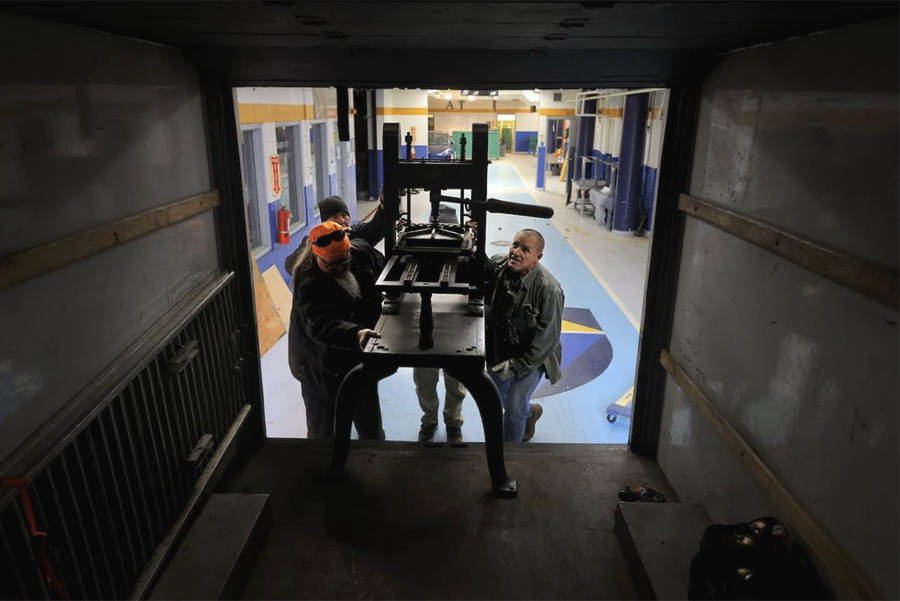
Mitchel Ahern, the director of operations at the Museum of Printing (left), and Peter Corriveau, the assistant director of operations at the museum, lift the press into the back of a truck for transport. Lane Turner/Globe Staff
Stored and forgotten in a cramped closet in a South End basement, a 200-year-old printing press — 600 pounds of iron, wood, and plenty of dust — lurched recently toward a new chapter in its long and mysterious life.
Hauled onto makeshift dollies at Franklin Cummings Tech, a two-year trade college, this throwback innovation from the early 19th century attracted a gaggle of admirers as it rolled toward a moving van parked on nearby, cobblestone alley.
The press, built by Adam Ramage of Philadelphia in about 1815, is among only two or three believed to remain in existence, according to Mitchel Ahern, operations director at the Museum of Printing in Haverhill.
As Ahern helped extract the machine, broad smiles and compliments from movers and school staff greeted the press as it slowly emerged from its hideaway.
“Very cool,” cooed Ahern, who said the press willreceive star treatment among the museum’s displays of printing’s centuries-long evolution.
“It’s really exciting to see a press like this pop up,” Ahern said. “In its day, this was printing technology. Our mission is to keep this kind of thing out of landfills.”
Its recent discovery at Franklin Cummings Tech, which is moving to Roxbury for the spring semester after 117 years in the South End, is a reminder of the school’s close association with Benjamin Franklin, the Boston-born printer and Founding Father whose generosity led directly to the college’s creation.
Franklin left 1,000 pounds sterling in his 1789 will to “the inhabitants of the town of Boston,” specifically for trade education, and noted that “good apprentices are likely to make good citizens.”
More than a century later, steel baron Andrew Carnegie matched Franklin’s gift on the condition that it be used for an industrial school and that the city donate the land. In 1908, with those conditions met, the school was dedicated as the Franklin Union. Jackie Cornog, chief of staff at the college, said the press had been forgotten as Franklin Cummings prepared for its move to Nubian Square.
Amid the bustle, the press appeared — unmarked, untended, and unobtrusive — tucked into a corner of a small, cluttered space at the bottom of the college’s four-story main building.
The Museum of Printing soon showed interest. And Dana Thomson, Franklin Cumming’s facilities director, began hammering away to open a space wide enough to remove the heavy press from the basement.
The work culminated in its departure for the Merrimack Valley when four people, bending and straining, provided the muscle to lift the press into the van.
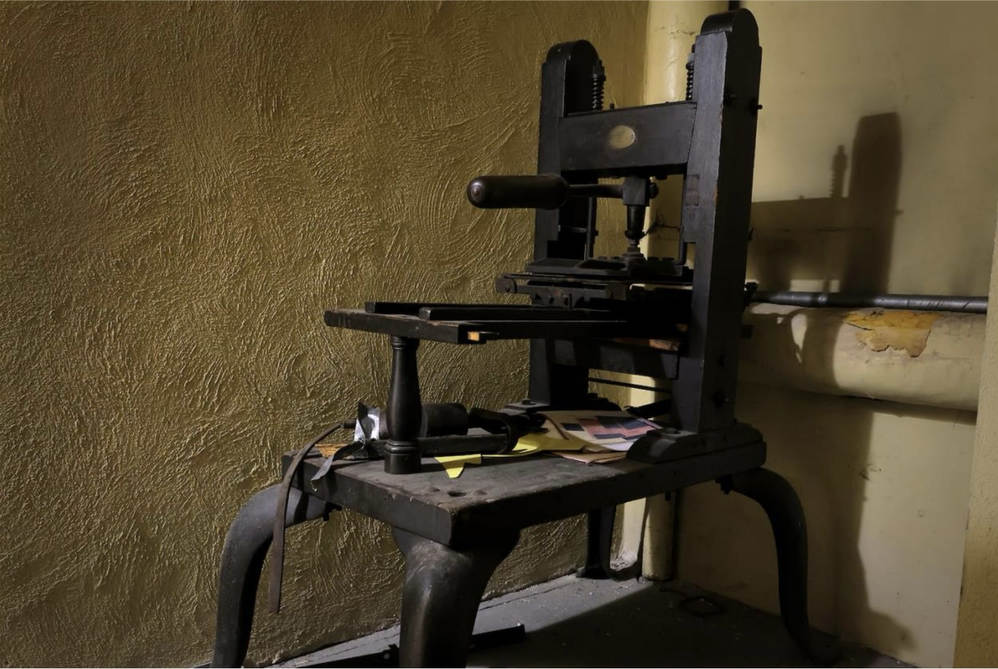
The printing press was tucked in an unused closet and weighs around 600 pounds.Lane Turner/Globe Staff
During a break in the move, Ahern noted that its hybrid design of wood and iron bridged a brief transition between completely wooden presses, which had been used for centuries, to machines made entirely of metal.
“Ramage was an innovator, and he was fine-tuning and tweaking the wooden presses, starting to change the design,” Ahern said.
The discovery of the press, which had been loaned to the collegeby the Bostonian Society many decades ago, is a reminder of Franklin Cumming’s educational mission, Cornog said.
“Being tied to history is so interesting, because this is just a building and we’re moving on,” Cornog said. “But in a sense, we’re still doing the same thing that we’ve done since the very beginning.”
Franklin’s presence is everywhere inside the main building’s expansive, marble-floor lobby. Murals of Franklin’s life ring the high walls, including one of Franklin at a printing press. Below them, a bust of Franklin, with moving tags attached, faces what once had been a steady stream of passers-by.
Franklin’s beginnings as a printer are what make the discovery so meaningful, Cornog said.
More than 1,000 students a year gain skills in disciplines as varied as electricity, automotive repair, HVAC, and opticianry, which is the grinding and fitting of lenses for eyeglasses and contacts.
Franklin Cummings officials say they believe the school offered the nation’s first college-based auto-repair program, soon after Henry Ford introduced the Model T in 1908. The college also was the scene of the first conference call, linking Boston, San Francisco, Chicago, Atlanta, Philadelphia, and New York in 1916, school officials said. And the first “telephoto” fax was sent from there in 1927.
Now, the printing press brings the school’s origins back full circle, she said. “Franklin wanted other folks to have opportunities to become entrepreneurs in the trades,” Cornog said. “It’s something that started him out.”
Although Franklin moved to Philadelphia as a young man after a falling-out with his brother, his will showed he retained a lifelong affection for his hometown, where he was born in 1706.
The affection goes both ways. Cornog recalled with a laugh that when she placed the moving tags on Franklin’s bust, the building’s fire alarm suddenly began screeching. “It seemed he was saying, ‘Either get the heck out or don’t leave,’ ” Cornog said.
< Mindy Mitrano 2026 ECCF Creative County Changemake | Bible Bound International Juried Exhibition >
Top ↑